

ART & RESEARCH projects stem from questions and often become collaborations, whether involving street cats, other artists, a group of Amazigh weavers, or a imaginative barista. A meaningful exchange starts with common ground, through curiosity, shared questions, and passions. The end result is never predetermined; each project unfolds via an experimental journey and slowly takes shape through unexpected events and the influence of other involved parties. By trusting the process, I may find answers, or I sharpen and adjust my questions.
Who cares for Tangiers' streetcats?
2026, Tangier, Morocco. Out of a shared interest in ecology and animal welfare grew my collaboration with Abdou Benattabou and his Donkey Museum in Tangier, outside the formal master program that had initially brought me there. It began with me making cat tents from recycled material, placed in public space for pregnant cats or young cat families to inhabit. This caught Abdou's attention and opened the door to working together.
Given the large number of (pregnant) cats in the city, we decided to interview people on the street about their attitudes toward cat care. This proved more complicated than expected. My European background was not neutral, it influenced how people reacted, or whether they were willing to talk at all. What does it mean to research in a place where you are, by definition, an outsider?
Are the many street cats in Tangier a problem
and what could be possible solutions?
Who is responsible?
The interviews taught me something the collaborative work at Darna's Women's House [p.1] could not. Creative processes already open people up when done together. Standing on a street corner asking strangers about cats, without that shared activity to lean on, I heard things far more unfiltered, a lesson in how the form of an encounter shapes what someone is willing to say.
I continued independently, filming the cats I cared for and other scenes I encountered: illegal animal markets, trash cleanups at abandoned cemeteries. The material became a video, installed inside a new cat tent made from torn clothing.
Community Herb Garden

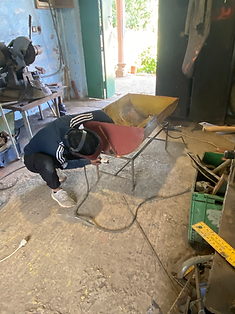


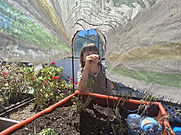


2026, Tangier, Morocco. Our group of master's students was paired with the Darna Association, a non governmental human development organization founded by a dozen artists and activists in 1995. At Darna's Women's House, women develop skills for the job market through cooking, pastry making, sewing, and weaving, work that directly serves the location's restaurant and artisan shop.
As a weaver and textile enthusiast, I was drawn to the large, empty rooftop space above the building, seeing an opportunity for a garden that could grow the herbs the restaurant already used in its cooking and tea. I teamed up with my classmate Dana Wait and together we met several times with staff of the Women's House to understand what herbs they needed and how to work with the intense summer heat. This shaped the project from the start: the idea began with us, but the direction came from the women who would actually use and care for it.
At another Darna location, we upcycled metal scraps through welding and painting to create raised plant beds, and made plant hangers from twenty liter water bottles collected and saved throughout our stay. We organised an event to install the garden and plant the herbs together with the staff, marking its launch as a shared effort rather than a finished gift handed over.
Can we contribute to a
more circular economy at Darna's Womenshouse?
Codes of Creation
2023 - 2024, Amekhlij, Morocco. Five years after working with Amazigh weavers in Morocco for my graduation project, I returned to reconnect and take our collaboration further with support from the Cultural Participation Fund. To make our work more professional, I created a work agreement based on the Fair Practice Code and tried to discuss it with the women—an experience full of trial and error due to our different backgrounds and roles in society (read more in the book below).
My aim is to support their journey toward financial independence and creative freedom. With each visit, our bond grows stronger, but without a shared language, progress takes time. Blending traditions with new ideas is both a challenge and an adventure, but I believe our connection, love for the craft, and creative exchange can open doors for artistic and personal growth for all of us.

How to establish fair working conditions together with women with whom I don't share a language or cultural and educational background?

After establishing a work agreement, we designed samples for a new work. As a design process is unusual for these women, I posed the question: does a carpet has to be square or rectangular shaped? We discussed what connects us, as women and weavers. This resulted in self-invented symbols, divided over unequally shaped pieces that fit together in multiple ways. Six women wove the samples, and I completed the finishings. Also, I compiled a book of photo’s and essays to document this journey photos (see below). My wish is to enlarge our body of work and also to show our work in Morocco.
Slotervaart in Transition
April/May 2023, Bureau Postjesweg Amsterdam. During our residency, artist Nina van Hartskamp and I explored how spatial developments, particularly gentrification, in Slotervaart impact the new and old residents.
We transformed Bureau Postjesweg into a temporary weaving, dyeing, and storytelling studio, inviting the public to participate by weaving, dyeing, or simply sharing a cup of tea and their stories. We hosted and recorded talk shows featuring guest speakers—writers Abdelkader Benali and Karima Assaoui, poet Chaimae Bouzagaoui, and local folk hero Abi Patat—who shared their experiences of living in the area, sparking deeper conversations with the audience.


How can we support local residents in sharing their perspectives on their quickly developing neighbourhood?
Each week, we brought a building fence—a functional loom and metaphor for gentrification—through Slotervaart, inviting passersby to weave garments into it. This process served as a conversation starter, enabling us to gather and record stories about their perspectives on the changes in the neighborhood.The transformed, vibrant fence was later exhibited at various locations in Slotervaart. Embedded within the woven fence were the stories of its residents, yearning to be heard.
Earth Pigments
2021, Amsterdam. It started by me wanting to buy paint and choosing pigments as those were the only ones I could understand the ingredients of - as they are one ingredient only. I fell in love with the deep and rich colors and wondered if I could dye yarn or cloth with them. Supported by the Cultural Participation Fund, I investigated this while learning more about the rich history of earth pigments and their role in the principles of the art world at Verfmolen de Kat in Zaandam. Through trial- and error experiments I found a way to steadily paint on cloth with the pigments, using fermented soybeans.


How to use earth pigments on fabric?
What was the role of pigments in the
history of art and language?
How can earth colors be revived in language and art, as a way of sharing individual voices on one surface?
Dialogues of the Figures
2021, Amsterdam. The project became more collaborative when I began inviting artists into my studio for a 'silent dialogue'. During sessions with Dané Vonk, Vicky de Visser, Yuni Chae, Jaap Kamsma, Aldo Brinkhof, and Yulia Ratman and Dorota Radzimirska of Day Collective, we painted symbolic answers together on a 1.5m² cotton cloth, responding to questions such as 'what do you miss in the lockdown?' and 'what are the most important values in your art practice?'. It was my way of holding visual dialogues and processing the loneliness of that time, using the same pigments people used to make their first artworks and communicative drawings on cave walls, 30,000 years ago.
The works were exhibited at buurthuis De Meeuw in Amsterdam Noord, April to May 2022.
Lola's Beasts
2025, Lolalieven, Amsterdam. I returned to earth pigments through a new commission for artspace Lolalieven, created together with artist Müge Yılmaz. We began with research into animals in the Netherlands, past and present, then invited local residents and visitors into artistic workshops to imagine animals from the past, future, and those they wish to protect, painting their visions with earth pigments. These canvases became a large patchwork tapestry, while some imagined creatures were transformed into wooden sculptures, also painted with earth pigments in collective workshops. Müge's challenge was finding a way to paint with earth pigments on wood, mine was exciting children to work with these muddy colors; the experimental mixing process helped with both. The textile and wooden beasts are now part of Lolalieven's interior, an artistic space open to visitors.


Dag, Oude Stamppot
March, 2020. Every day, the news announces the latest updates on the coronavirus and its mortality rate. Over a cup of coffee, baristo Leonardo Guidi and I dreamed about how this cold number could be made more tangible and whether it would encourage people to feel more empathy for each other.
This is how Dag, Oude Stamppot was born: an interactive installation inviting Amsterdammers to share memories of those they missed through recipes tied to them. Scent and taste are powerful memory triggers. Cooking habits, family stories, and photos were shared online and shredded on-site. The growing pile of paper visualised the mortality rate, a stark reminder of the virus’s impact. Each Friday, Leonardo and I ritually shredded new submissions in the window of Gallery Hooffzaak, while some participants performed the act themselves as a farewell.
The collection grew beyond recipes—flyers from canceled events, unused tickets, unpublished books, even an unfilmed movie script—as interrupted dreams and lives took shape. All memories, photos, and stories remain documented ondagoudestamppot.nl in agreement with the participants.
Can we make the impersonal mortality rate of the pandemic more tangible?

